The City of Busselton has prepared the information on this web page to explain the current operation of the Dunsborough Waste Facility, advise of planning for the proposed Landfill Cell 3, groundwater monitoring results, and further investigations being undertaken under the oversight of the Department of Water and Environmental Regulation.
The Dunsborough Waste Facility is located off Vidler Road at 48 Western Cape Drive, Naturaliste. It is the City’s only landfill site and accepts waste from within the City of Busselton. It has operated as a landfill site for the last three decades.
The Dunsborough Waste Facility operates under an environmental licence issued by the Department of Water and Environmental Regulation.
The current landfill cell, Cell 2, is expected to reach capacity in 2027. The City is planning for a new lined landfill cell, Cell 3, within the existing facility site. The existing licenced area is not expanding. The plan is for Cell 2 to close and Cell 3 to open to enable existing operations to continue.
Cell 3 is required because no alternative option has been identified that can replace local landfill capacity in the short to medium term in a cost-effective, environmentally appropriate and operationally reliable way.
Early history and current operations
The Dunsborough Waste Facility is located off Vidler Road at 48 Western Cape Drive, Naturaliste, and is currently the City of Busselton’s only landfill site.
Under the Waste Avoidance and Resource Recovery Act 2007 (WA) and the Local Government Act 1995 (WA), Western Australian local governments are legally mandated to manage and provide essential waste management services. These encompass:
- the collection, transport, storage, treatment, processing, sorting, recycling, or disposal of waste;
- the provision of receptacles for the temporary deposit of waste; and
- the provision and management of waste facilities, machinery for the disposal of waste, and processes for dealing with waste.
As part of the City’s historic waste management strategies in the 1980s, the area along Vidler Road, where the Dunsborough Waste Facility is located, was identified as the preferred location for the City’s future waste management operations, including as a putrescible landfill site.
The Dunsborough Waste Facility is surrounded by privately owned land (a mixture of cleared paddocks and undulated bushland), whilst the Leeuwin-Naturaliste National Park is located approximately 1km to the west.
The City acquired the site in 1984 and in August 1990 the site was officially approved by the WA Department of Health (and as such gazetted) as a refuse disposal site. Historic records indicate that landfill operations at the Dunsborough Waste Facility commenced in 1990 and the City has been using it for that purpose since. Other than obtaining approval from the Department of Health, at that stage waste disposal operations in WA were largely unregulated.
Although the licencing of major waste disposal sites in WA commenced shortly after the Environmental Protection Act 1986 (WA) (EP Act) was passed in 1986, it was not until a decade later (in 1996), that minor rural sites (such as the City’s Rendezvous Road site and the Dunsborough Waste Facility) were formally required to be licenced as “prescribed premises” under relevant legislation. In accordance with abovementioned regulatory framework, the City was granted a licence under Part V of the EP Act by the Department of Environmental Protection (DWER) in June 1998, for the use of the Dunsborough Waste Facility as:
- Category Number 64: Putrescible Landfill Site
- Category Number 61: Liquid Waste Facility
Licenced operations
Pursuant to the Part V Licence, the Dunsborough Waste Facility has been continuously used for waste disposal and waste treatment purposes since 1998.
When waste disposal operations were terminated at the City’s Rendezvous Road site in 2012, the Dunsborough Waste Facility became the City’s only landfill site.
This site is not, and never has been, designated as a regional landfill site, and was never established with the purpose of accepting waste from other local government areas.
Under the current Part V Licence, which is valid until 2030, the following operations are permitted at the Dunsborough Waste Facility:
|
Type
|
Assessed production / design capacity
|
|
Liquid Waste Facility
Premises on which liquid waste produced on other premises (other than sewerage waste) is stored, reprocessed, treated or irrigated.
|
Up to 8,000 tonnes per year
|
|
Solid Waste Depot
Premises on which waste is stored or sorted pending final disposal or re-use.
|
10,000 tonnes per annual
period
|
|
Class II or III Putrescible Landfill Site
Allowing acceptance and burial of municipal waste such organic waste (e.g. food scraps, green waste pruning) and other non-organic waste from household and commercial premises, including asbestos (but not other hazardous waste or clinical waste).
|
Up to 35,000 tonnes per year
|
|
Crushing of Building Material
Allowing crushing or cleaning of waste building or demolition material, such as bricks, stones or concrete.
|
50,000 tonnes per annual period
|
Prior to 2018, the City’s municipal solid waste had been buried in unlined cells at the Dunsborough Waste Facility as this was the accepted practice for landfilling across the State at the time.
Since 2018, in accordance with the State Government’s environmental regulatory framework and current environmental best practice guidelines, waste is buried at the Dunsborough Waste Facility in lined cells.
A lined waste cell is a type of landfill cell constructed with an impermeable barrier to prevent leachate (liquid that forms when waste decomposes) from seeping into the ground in order to reduce the environmental impacts of the buried waste to a minimum.
The Dunsborough Waste Facility currently landfills approximately 28,000 tonnes of municipal solid waste and processes approximately 8,000 tonnes of liquid waste per year from residential and commercial properties within the City of Busselton.
A range of recycling options are also offered at the Dunsborough Waste Facility to reduce recyclable items ending up in landfill, including scrap metal recovery, car batteries, household recycling, household batteries, commercial and domestic quantities of cardboard, motor oil, electronic waste, fluorescent tubes and globes, gas bottles, and household hazardous waste.
Why was the Dunsborough Waste Facility preferred for waste disposal?
The decision to establish a waste facility at the Vidler Road site was based upon, among other things, hydrogeological investigations which confirmed the suitability of the site for municipal waste landfill operations. Expert advice obtained by the City at the time reported that the Dunsborough Waste Facility:
“ …. is underlain by sands, sandy clays and bedrock and therefore the site is generally well suited to refuse disposal by landfill”
This advice concluded that:
“The lithological and hydrological results render this site well suited for future sanitary landfill.”
Elsewhere in the district, large areas are located on what is classified as the Swan Coastal Plain with a relatively high water table which poses a risk of groundwater contamination. This has since been acknowledged by the Minister for the Environment who stated in 2024:
“The Government’s policy is to not allow the establishment of any new putrescible landfills on the Swan coastal plain. “
Has the City considered alternative sites or solutions?
The City is currently preparing a Draft Strategic Waste Management Plan based on the latest industry information and analysis of future needs and requirements. This is anticipated to be advertised for public consultation in 2027.
Prior to this, the following research was undertaken by the City:
- Potential new landfill sites have been investigated at a number of locations within the City of Busselton over the past 30 years. These include the Willcock pine plantation on Vasse Highway, a gravel pit at Jindong, a gravel pit at Slee Road and a pine plantation at Ridge Road. These sites were assessed as not suitable for, among other reasons, considerations such as ecological values and high water tables.
- In 2014, the City participated in a research project with a group of South West local governments to investigate the possibility of establishing a regional landfill site, which identified 37 sites across the South West for further investigation. Initially a site in Dardanup was assessed as the most suitable and $4.2mill State Government funding was secured to purchase this land, but the Shire of Dardanup made the decision to sell the land to a third party instead. More recently, a site located on Goodwood Road between Capel and Donnybrook was also assessed as being suitable, but more recent investigations indicated that this site had high environmental values and logistical concerns which affected its suitability. As a result, the Shire of Capel withdrew its support for this site which effectively terminated that project.
- In 2021, ten South West local governments (including the City of Busselton) collectively invited expressions of interest from suitably experienced waste management experts to provide solutions for sustainable, long-term management of municipal solid waste in the South West. Submissions received included technologies such as Thermal Waste-to-Energy (incineration), Biological Waste-to-Energy (anaerobic digestion), manufacturing of refuse derived fuel and transporting waste to alternative landfill sites. However, the outcome of this project was that none of proposals offered a viable cost/benefit solution.
- Based on operational needs, the City does occasionally send municipal solid waste for landfill to a Dardanup landfill facility. The cost of doing so significantly exceeds the cost of using the Dunsborough Waste Facility so this is therefore not considered to be a permanent solution.
- In 2025, eight South West local governments (including the City of Busselton) collectively invited tenders for the processing of Food Organics and Garden Organics (FOGO) waste to investigate whether, on the basis of an economy of scale, the viability of such a project. For reasons such as insufficient volumes, strict contamination requirements and the cost to participating local governments, this solution was assessed as not viable.
- The City’s investigations into the transporting municipal solid waste to a Thermal Waste-to-Energy plant in Perth indicated that the costs would significantly exceed the benefit. The nearest plant is at Kwinana where, in addition to the cost of transport, a “gate fee” (currently in excess of $160/tonne) is charged.
To date none of these solutions have demonstrated a cost effective, environmentally efficient and sustainable solution as a short to medium term alternative for the City’s current landfill operations.
What short to medium term initiatives are planned for the Dunsborough Waste Facility?
The City of Busselton has a legislated function to provide regular kerbside collections and local waste transfer, recycling and disposal facilities.
The City is currently developing a new Draft Strategic Waste Management Plan to inform long term solutions, however, in the absence of currently viable alternative solutions and as an interim measure, the City considers it prudent and responsible to continue planning to ensure there is adequate local landfill capacity over the short to medium term.
Landfill Cell 2, which is currently being used for landfill operations, came into operation in 2023 and is expected to reach full capacity in 2027.
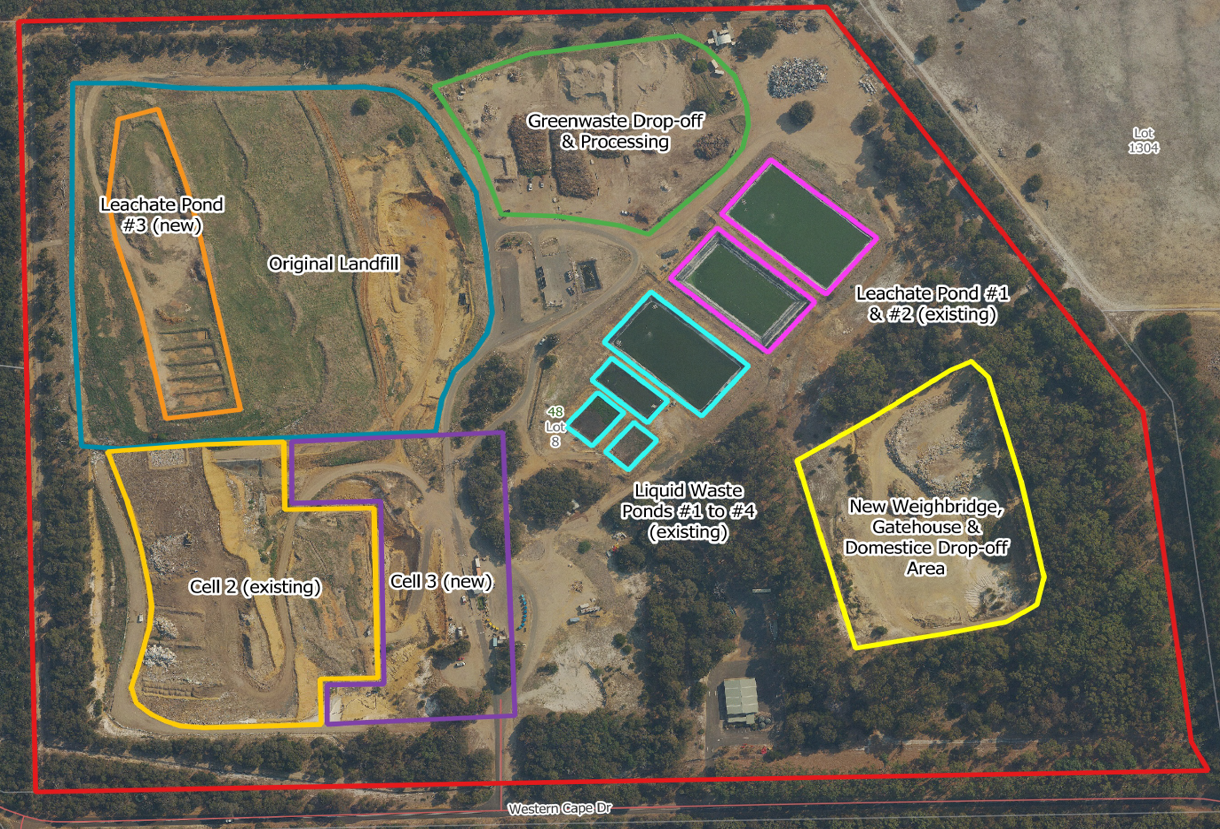
In accordance with the City’s 2021 Waste Plan (as supported by the Council Plan 2024 – 2034), the City is progressing the development of Landfill Cell 3. This will be constructed immediately to the east of existing Landfill Cell 2 and will be supported by a new Leachate Pond 3 which will be constructed in the northwestern corner of the site. All works will be fully contained within the existing Dunsborough Waste Facility site and fall within the existing Part V licenced area. Landfill Cell 3 will, for all practical purposes, be an extension of existing Landfill Cell 2, and will have an indicative lifespan in excess of 10 years.
Other planned upgrades to the Dunsborough Waste Facility include a new weighbridge, gatehouse and domestic drop off areas.
How will Landfill Cell 3 operate?
Landfill Cell 3 has been designed in accordance with the 2014 Victorian Landfill Best Practice Environmental Management – Siting, design, operation and rehabilitation of landfills and in compliance with the Western Australian regulatory framework.
The construction of Cell 3 can only proceed if it satisfies strict State Government environmental assessment and approval requirements. Modern landfill facilities are engineered to protect groundwater and the surrounding environment through lining systems, leachate management, environmental monitoring and other controls. Any approval will include conditions designed to avoid, minimise and manage environmental impacts throughout the life of the facility.
Cell 3 has been designed as follows:
- A synthetic liner system comprises of a Geosynthetic Clay Liner, followed by a 2mm High Density Polyethylene (HDPE) liner and a cushion protection geotextile layer.
- A leachate collection pipe network on top of the lining with a 50mm drainage aggregate layer placed on top.
- A separation geotextile installed on top of the aggregate.
- The new Leachate Pond 3 will be 1.5 metres deep, with a leachate management system designed to extract and manage landfill leachate from Landfill Cell 3.
Construction will involve soil excavation to a depth of approximately 12 metres below the natural ground level which will allow for the synthetic lining system of Landfill Cell 3 to tie into the existing synthetic lining systems of Landfill Cells 1 and 2.
As a remediation measure, the new Leachate Pond 3 will be constructed on top of the original landfill area and lined with impermeable materials to reduce and mitigate rain and storm water penetration into the original landfill area. This will, in turn, reduce the formation of landfill leachate in this area.
A 1.8 metre fence will also be installed around the new Leachate Pond 3, with a 4 metre wide gate in the southeastern corner to allow access for maintenance purposes.
In accordance with regulatory requirements, the City applied to DWER in 2026 for a new works approval to progress construction of Landfill Cell 3.
Once a works approval has been obtained, the City will invite tenders for construction of these works. It is anticipated that Landfill Cell 3 will be operational by late-2027. Based on current fill rates, Cell 3 will provide the Dunsborough Waste Facility with an extended lifespan of at least 10 years.
What waste strategies and plans does the City have in place?
The WA State Government’s Waste Avoidance and Resource Recovery Strategy 2030, which was published in 2019, sets a statewide vision to transition the state into a sustainable, low-waste circular economy with the key objectives to:
- Avoid: Generate less waste across the community.
- Recover: Recover more value and resources from materials.
- Protect: Protect human health and the environment by managing waste responsibly.
All local governments and regional councils in the Perth and Peel regions, and those in major regional centres (including Busselton) that provide waste services were required to prepare a waste plan outlining how waste services will be managed to achieve consistency with abovementioned State Government strategy.
The City of Busselton prepared a Waste Plan which was endorsed by the Council in June 2021 and approved by DWER in July 2021. DWER representatives commented on the City’s Waste Plan 2021 in writing as follows:
I commend the City of Busselton’s commitment to reducing waste, increasing resource recovery, and protecting the environment. I consider that the City of Busselton is implementing initiatives that are consistent with, and contribute to, the delivery of the targets and objectives of the State’s Waste Avoidance and Resource Recovery Strategy 2030 …
and
I am pleased to endorse the City of Busselton’s waste plan and wish you success with its implementation.
The City is required to review its Waste Plan annually and, where necessary or appropriate, update it. The most recent Waste Plan report (for the 2024/25 reporting period, submitted on 10 December 2025) has been accepted by DWER.
At this stage, the City’s Waste Plan anticipates the capacity of and future need for the Dunsborough Waste Facility as follows:
- Remaining Capacity – 25 years (this will require construction of further landfill cells in due course)
- Anticipated closure – 2045
Development of Western Australia's waste policy framework is ongoing. Currently Western Australia’s State Waste Infrastructure Plan (released in May 2024) provides a long-term outlook to 2050 for building and managing recycling and recovery facilities, while Beyond WAste 2030 serves as the state's updated draft strategy and five-year action roadmap guiding the transition to a circular economy. The City continues to have due regard to these plans and strategies as part of the City’s ongoing waste management planning.
The City of Busselton Council Plan 2024 – 2034, adopted by Council in 2024 and updated annually, articulates the vision, outcomes and strategic priorities of the City for the next ten years and outlines how priority projects will be delivered over the next four years. In accordance with this plan, the City’s waste management operations are currently under review for purposes of developing a new Draft Strategic Waste Management Plan which will be presented to the Council in 2027. Community members will be encouraged to contribute to the development of this plan through a community engagement process which is anticipated to take place in 2027 prior to the Council being asked to consider adoption of the plan.
What do current State Government policies and strategies say about waste management?
The WA State Government developed a Waste Avoidance and Resource Recovery Strategy 2030 (Waste Strategy 2030) that builds on Western Australia’s previous waste strategy Creating the Right Environment, which was introduced in 2012 and achieved significant improvements in recycling, reducing waste generation, diverting construction and demolition waste, and better managing commercial and industrial waste.
All local governments and regional councils in the Perth and Peel regions, and those in major regional centres (including Busselton) that provide waste services were required to prepare a waste plan outlining how waste services will be managed to achieve consistency with the Waste Strategy 2030 and protect public health and the environment.
Development of Western Australia's waste policy framework is ongoing. Currently the State Waste Infrastructure Plan (released in May 2024) provides a long-term outlook to 2050 for building and managing recycling and recovery facilities, while Beyond WAste 2030 serves as the State's updated draft strategy and five-year action roadmap guiding the transition to a circular economy. The City continues to have due regard to State waste management policies as part of the City’s ongoing waste management planning, including the draft Beyond Waste 2030 and the State Waste Infrastructure Plan 2024.
Contaminated site investigations at the Dunsborough Waste Facility
The Contaminated Sites Act 2003 (WA) establishes a framework for identifying, reporting, investigating and managing land contaminated by hazardous substances. It works alongside the Environmental Protection Act 1986 to protect human health and the environment. Contamination does not necessarily mean that an area is unsafe to live or work in. For example, it may be limited to groundwater and may only become an issue to be managed if use of water from a groundwater bore could impact on human health or the environment.
Pursuant to its functions and powers under the Contaminated Sites Act, DWER may classify a site if, based on reasonable grounds, a site is, or is known (or suspected) to be, contaminated. All landfill sites in WA are by default classified as possibly contaminated.
The Dunsborough Waste Facility was classified by DWER in 2010 as possibly contaminated – investigation required. This classification is assigned when historical land use or preliminary reports suggest contamination, but a complete assessment has not yet been done.
A network of ground water monitoring bores within the boundary of the Dunsborough Waste Facility were installed by the City in the early 2000s to assess the quality of groundwater beneath the landfill site. In accordance with the facility’s licencing conditions, these bores have been tested for a range of analytes twice-yearly since 2006, and the test results submitted to DWER on an ongoing basis.
In 2021, DWER advised that a review of the 2019 groundwater monitoring results for the Dunsborough Waste Facility indicated that bores located near the western boundary of the site appeared to be impacted by landfill leachate, most likely originating from the initial (unlined) landfill cell at the site. Consequently, DWER requested the City engage a suitably qualified environmental consultant to assist in undertaking further groundwater investigations.
These further investigations have since indicated that:
A number of substances indicative of landfill leachate are present in groundwater at the western (down gradient) boundary of the Dunsborough Waste Facility, at concentrations exceeding non-potable use guidelines. Perfluorooctane sulfonic acid (PFOS) has been found in some on-site bores above the relevant guideline values for protection of freshwater ecosystems but not exceeding the Australian drinking water guideline values.
Two off-site monitoring bores were installed in 2023 beyond the western boundary of the Dunsborough Waste Facility in locations more than 400 metres from the site boundary. The closest off-site bore is approximately 400 metres from the site boundary. Practical constraints such as the topography of the land and dense vegetation restricted the ability to install bores closer to the site. Apart from a low-level detection of PFOS in one of these bores, no leachate impacts were identified in these off-site bores.
In response to the outcome of these investigations, DWER has since advised that:
- Based on current data, health-risks associated with potential exposure to site-derived contaminants in groundwater by off-site groundwater users are ‘low and manageable for existing off-site land uses’.
- Further investigations are required to improve understanding concerning the likely presence of subterranean ecology and the risks posed to such ecology.
- As further investigations and management of contamination issues at the Dunsborough Waste Facility are impacted by particularly complex technical issues (such as complex underlying hydrogeology and limited practical access to key areas) the City is required to engage a Contaminated Sites Auditor to oversee further investigations.
What is the City doing now to monitor any potential risks?
In line with DWER requirements, the City engaged a Contaminated Sites Auditor in December 2025. In March 2026, the City also procured the services of a suitably qualified and experienced environmental consultant to continue further investigations.
Further investigations have commenced in line with the recommendations of this consultant, and their findings will be independently reviewed by the Contaminated Sites Auditor and DWER.
The City is permitted to continue operating the Dunsborough Waste Facility under the Part V licence issued by DWER while the investigations under the Contaminated Sites Act are ongoing.
General Information and Advice for Property Owners
What is PFOS?
PFOS (perfluorooctanesulfonic acid) is a human-made chemical, one of many in the PFAS (per- and polyfluoroalkyl substances) family, used in products like stain and water repellents, firefighting foam and coatings for food packaging and consequently is already present in the environment. Known for resisting heat, stains, grease, and water, PFOS is a "forever chemical" because it does not break down easily and accumulates in the environment and human bodies. As PFOS is present in many household and other commonly used products, it can accumulate in landfills and enter the environment from unlined landfill cells.
For more information in relation to PFAS see the Department of Water and Environmental Regulation (DWER) website: DWER’s website.
What is a Contaminated Sites Auditor?
In Western Australia, a contaminated sites auditor is a highly experienced, accredited environmental consultant who provides an independent, third-party review of site assessment and remediation work for a potentially contaminated site under the Contaminated Sites Act.
Auditors must be accredited by DWER and are required to undertake an independent review of test results, site assessments and/or remediation work carried out by other professionals in relation to a potentially contaminated site.
Can I use water from groundwater sources on my property?
Property owners should obtain advice from DWER in relation to restrictions on the use of groundwater at their properties.
Property owners and residents are also reminded of the general standing advice from the Department of Health that:
“Bore water should never be used for drinking, bathing, watering edible plants, filling swimming and paddling pools, food preparation or cooking unless it has been tested and treated to the extent necessary for the intended use”.
Where can I find further information?
All technical reports submitted by the City and its consultants with DWER for the purposes of the Contaminated Sites Act are available to the public through a request to DWER for a ‘detailed summary of records’ (DWER Form 2). Please note that a fee may apply.
I have concerns about these contamination issues, what can I do?
You can contact:
City of Busselton
city@busselton.wa.gov.au
08 9781 0444
and/or
Department of Water and Environmental Regulation (DWER):
www.dwer.wa.gov.au
(08) 6364 7000