Weed Control
The City controls weeds for several reasons;
- to reduce the spread of invasive weeds
- for the protection of assets
- and the presentation of the City.
Weed management in natural areas differs substantially to parks and urban landscaping areas due to the difference in weed density and biodiversity.
Weed Control Methods – an integrated weed management approach
The City uses and trials a variety of weed control methods.
- Physical - Hand removal / mulching / smothering
- Chemical - Synthetic or organic herbicides
- Mechanical - Slashing / mowing
- Hydrothermal - Steam / hot water (the City has trailed this methodology, although at high cost and limited efficacy)
Weed control operations
The City undertakes weed control across its road reserves, public open spaces and infrastructure assets through a combination of scheduled and targeted unscheduled programs.
Scheduled Weed Control
Bridges and Essential Infrastructure
Weed and vegetation control is carried out around bridge infrastructure twice each year to help protect assets and maintain safe access for inspections and maintenance.
Rural Roads
Road shoulders in rural areas are sprayed or slashed annually to manage vegetation growth and maintain road safety.
Urban Roads and Footpaths
Foot paths, kerbs and median islands within urban areas receive between two and four weed control treatments each year, depending on seasonal growth. This helps protect infrastructure and ensures safe access for pedestrians and road users.
Sports Grounds
The City manages pests and weeds on sports grounds through an annual turf management program. This supports healthy, resilient playing surfaces for community use throughout the year.
Targeted Unscheduled Weed Control
Parks and Streetscapes
Where required, the City undertakes minimal, targeted spot spraying in parks, gardens and streetscapes to control invasive weeds. This approach is used selectively to address specific weed outbreaks while minimising chemical use.
Notification and Signage
The City will display scheduled sports grounds applications on the City’s Works around your Neighbourhood webpage and signage around the ground during application.
The City does not provide prior notification for unscheduled activities which are targeted minor spot applications within parks / verges / kerbs / footpaths. The majority of weed control is carried out during high growth periods of intermittent rainfall, hence applications and scheduling remains fluid between weather patterns, making accurate prior notifications of unscheduled applications very difficult.
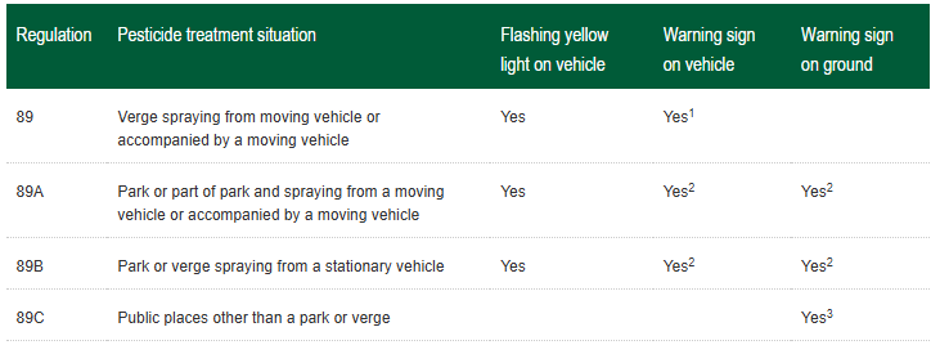
The City will display signage as per the table below, noting moving vehicle applications do not require in ground signage as per DoH guidelines.
Products
The City uses the lowest toxicity products available which are both selective and non-selective methods.
Non-selective: these products eliminates all contact species. For example, rather than using high-strength commercial glyphosate, the City uses Weedmaster Duo which is a very low dose form, officially classified as non-hazardous (see details below).
Selective: product is formulated to target only specific species eg broadleaf weeds, fungus or pests in sports turf.
Glyphosate
Glyphosate is currently the industry standard herbicide treatment for broad spectrum weed control across roads, kerbs, footpaths, drains, gardens, natural areas and revegetation sites. The City of Busselton is responsible for managing thousands of kilometers of road reserves, footpaths, cycleways, parks, firebreaks and natural reserves. To do this effectively, we require a range of efficient and cost-effective weed control solutions.
All herbicide use by the City and its contractors is regulated by the Australian Pesticides and Veterinary Medicines Authority (APVMA) and the WA Department of Health. For your reference, we have attached an information sheet outlining the relevant regulatory framework.
The City is aware of community concerns about herbicide use and takes measures to minimise risk wherever possible. We avoid applications near schools, bus stops and high-profile public locations at key times, and we do not apply herbicides in high winds or when rain is forecast.
We recognise that some countries have chosen to restrict or ban glyphosate use. These decisions are often precautionary or targeted at high-concentration agricultural products used in large-scale farming. By contrast, Australia applies one of the strictest regulatory systems in the world through the APVMA, which has undertaken multiple independent reviews of glyphosate. The findings have consistently confirmed that glyphosate, when used according to label directions, does not pose an unacceptable risk to human health, animals or the environment. The APVMA continues to monitor new evidence and reviews its approvals regularly.
It may also be helpful to note that glyphosate comes in a variety of formulations and strengths depending on the application.
The City uses a very low dose form, Weedmaster Duo Salt Herbicide, which is officially classified as non-hazardous in its concentrated form (see Hazard identification below). This concentrated form is then diluted with water at just 2% dilution (hence just 20ml of a non-hazardous product within 1 litre of water). In environmentally sensitive areas, we also use Roundup Biactive, a water-soluble, non-volatile formulation with an ‘aquatic-approved’ surfactant that is specifically designed for use near streams, creeks, drains and other waterways.

It is also important to note that many of the alternatives to the City’s low-dose glyphosate are less effective, more hazardous, or require higher application rates. For example, some substitute herbicides have greater toxicity to humans and animals, longer persistence in soil and water, or carry increased risks of off-target damage to native plants. Where practical, alternative methods such as mowing, slashing, mulching and hand removal are also used, and the City continues to trial new approaches.
The formulations used by the City are carefully selected to be safe for public and environmental use and are applied in a targeted way by qualified contractors and staff. Our practices strike a balance between effective weed control, cost efficiency, and protecting the health of our community and natural environment.
Any weed control of footpaths and kerbs by contractors is carried out to meet Department of Health legislation including operating signage.
However, residents may request their address be added to a ‘no spray register’ kept by the City by sending a request to Customer Service on city@busselton.wa.gov.au.
Collaboration
The City is part of the Western Australian Local Government Association’s (WALGA’s) Local Government Integrated Weed Management Working Group. Please refer to the below WALGA Fact Sheets.
Fact Sheet 1 - Overview of IWM Working Group
Fact Sheet 2 - Local Government integrated weed management practices
Fact Sheet 3 - Benefits and limitations of weed control treatments
Fact Sheet 4 - Protection of public health and environmental values
Fact Sheet 5 - Weed control on private property
Fact Sheet 6 - Frequently Asked Questions