Budget 2026-2027
The City of Busselton Council has now adopted its 2026/27 annual budget, continuing to drive its vision of being a place “Where environment, lifestyle and opportunity thrive”.
With operating expenditure of $135M and capital investment of $63M, this year’s budget enables ongoing delivery and improvement to a wide range of services and facilities. There is a strong focus on delivery of key actions from the City’s Council Plan 2024-2034 that will continue to enhance, strengthen and support our growing and diverse community.
The 2026/27 annual budget not only considers current needs; it also makes provision for future long-term investment in community infrastructure. Development of enhanced sport and recreational facilities that meet the needs of our growing population remains a clear community priority, so this year there is an increase in the allocation of total rates revenue into the New Sport and Recreation Facilities and Infrastructure Reserve, with $2.7M or 3% of total rates revenue being put aside for this purpose.
There are a number of community-focused projects on the list for delivery this year:
- $6.4M (carried over from 2025/26) for construction of the Dunsborough Lakes Sporting Pavilion
- $9.5M in footpath and cycleway construction, including funding for a new unsealed trail from Castle Bay to Meelup Beach and $5.9M for the progression of works on the Wadandi Track (which is all grant funded)
- $4M (including $1.6M carried over from 2025/26), to complete the final works on Saltwater Busselton, the City’s state-of-the-art Performing Arts and Convention Centre, enabling it to operate to its full capacity
- $1.5M for upgrade works at the City’s Leisure Centres, including replacement of the Pool Liner
- $500K for continuation of planning and design on a squash facility
- $300K towards progression of improved facilities at Dunsborough Districts Country Club;
- $250K for lighting upgrades at Barnard Park Oval
- $520K for various renewal and upgrade works to public ablutions, including $400K for the construction of a new toilet at Holgate Reserve
- $740K for various renewal and upgrade works to the City’s Aged Housing assets
- $20M to improve City’s road network, including works on Ludlow-Hithergreen Road and Hairpin Road
- $300,000 for development of a new district-wide traffic study to guide future road network planning
- $4M for parks, gardens and public open space reserves, including $330K for playground upgrades in various locations
- $3.1M for the continuation of various coastal protection works along Geographe Bay
- $3.2M in various new and upgrade works at the Busselton Margaret River Airport
The City is also investing into other important community priorities detailed within the Council Plan, including funding to undertake a youth needs analysis across Vasse and Yalyalup, development of a Community Safety Action Plan, commencement of a review of the City’s Local Planning Strategy to support responsible future development, and a service review program to ensure continuous improvement and service efficiency. There is also continuation of funding for improving emergency access ways.
It is important that as a Council we remain agile and respond to changing economic and community circumstances. Having considered both the need to invest in the delivery of services and priorities that provide for our growing population along with community concerns around affordability and cost of living, this budget, underpinned by an average residential rate increase of 6.2% aims to achieves the right balance.
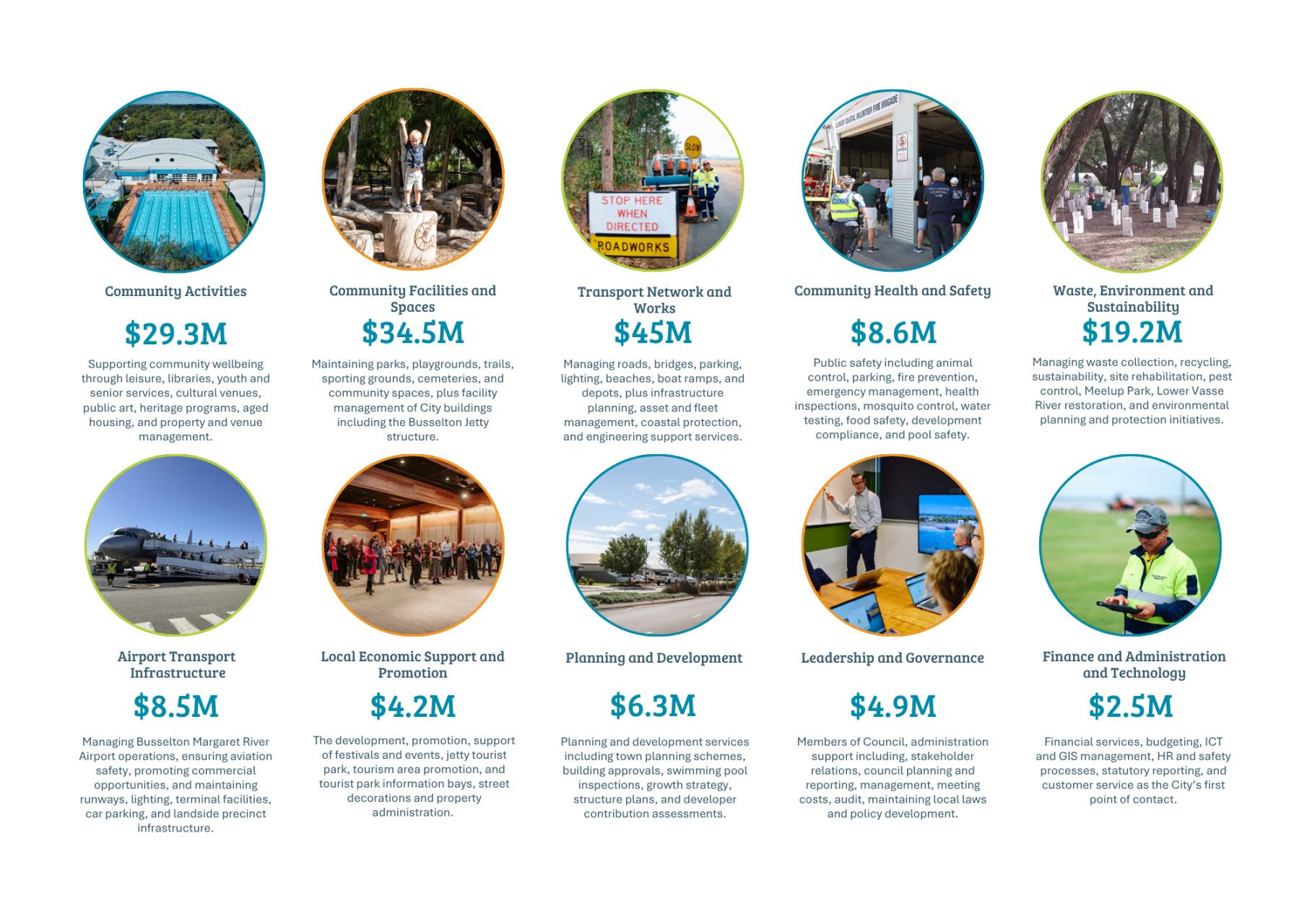
Budget Highlights 2026/2027
Figures represent operational and capital expenditure, including corporate allocations. Numbers have been rounded for accessibility.
Related Information
2026/27 - Adopted Annual Budget
2026/27 - Adopted Schedule of Fees and Charges
Mayor's Message 2026-2027 Budget Summary
You can view a recording of the debate on the City's YouTube page >>
You can view the Council Plan 2024-2034 here >>
2026/27 Budget Presentation
The City hosted a Budget Breakfast on Tuesday, 4 August to provide an overview of the 2026/27 Budget. It provided an overview of the key considerations, assumptions and investment decisions that informed the development of the budget, including the extensive involvement of the Mayor and Councillors throughout the process.
While a recording of the presentation was made, the quality did not meet the standard required for publication. To ensure the information remains accessible, the presentation slides have been made available together with the summary below.
Budget Breakfast Presentation 2026/2027 - 4 August 2026
Introduction and Council Involvement
Slides 1-5 contain the Mayor's introductory remarks, providing context for the budget and outlining the significant role of the Elected Members in shaping priorities and reviewing budget assumptions prior to adoption.
Budget Framework and Key Drivers
Slides 6-12, presented by the CEO, explain the legislative and financial framework that underpins the budget development process.
These slides cover:
- The legislative requirements associated with the Strategic Community Plan, strategic performance reporting, annual budgets and financial statements (Slide 6).
- The key economic, demographic and operational factors influencing budget estimates (Slides 7-9).
- The process used to incorporate Elected Member input and the core data that forms the basis of budget calculations (Slides 10-12).
Particular emphasis is given to two important components of budget preparation:
- The Local Government Cost Index (LGCI), produced by WALGA, which provides guidance on cost movements and inflationary pressures affecting local government operations.
- The City's Capital Works Program, which identifies the infrastructure, renewal and improvement projects planned for delivery during the financial year.
Service Delivery Costs
Slides 13-16, presented by Sarah Pierson, Director Corporate Strategy and Performance, provide an overview of the City's service areas and the expenditure associated with delivering those services.
These slides outline the cost of individual services provided across the City and the resources required to maintain service delivery to the community.
Key Projects and Initiatives
Slides 17-30, presented by the CEO, highlight the major projects, programs and strategic initiatives planned for the 2026/27 financial year.
These projects represent Council's investment in infrastructure, community facilities, economic development and service improvements across the district.
Financial Overview
Slides 31-43, presented by the Director Corporate Strategy and Performance, provide a detailed overview of:
- Operating revenue
- Operating expenditure
- Capital expenditure allocations
- Overall budget composition and funding sources
These slides demonstrate how the City's financial resources are allocated to support service delivery, asset renewal and strategic investment priorities.
Procurement Opportunities
The presentation also included an overview of upcoming procurement and contracting opportunities associated with the City's capital works and operational programs, providing insight into future opportunities for suppliers and contractors.
Questions and Answers
The presentation concluded with a question-and-answer session, during which a range of matters relating to the budget, projects, services and financial assumptions were discussed. A total of 10 questions were raised and addressed by members of the City's leadership team and can be viewed below.
The presentation slides provide a comprehensive overview of the key considerations, priorities and investments that form part of the City's 2026/27 Budget.
If the population is increasing by 30%+ in 10 years, can the City do scenario plan modelling re impact on current infrastructure and future planning decisions?
Yes. Scenario planning is an important tool for understanding the potential impacts of population growth on infrastructure, services and future planning decisions.
The City has already undertaken scenario planning exercises with Elected Members and staff to explore different development and growth outcomes. These exercises help identify opportunities, challenges and infrastructure requirements that may arise under various growth scenarios.
A key benefit of scenario planning is that it encourages consideration of future possibilities without being constrained by existing arrangements. This enables strategic thinking about what may be required to support the community as it grows, before evaluating how current infrastructure, policies and services may need to adapt.
As population growth projections continue to be considered, scenario planning would be a valuable approach to inform future planning and investment decisions.
Are we able to access the slideshow after so we can read?
Yes. The presentation slides will be made available following the event and can be accessed on the City's website.
Has the City considered selling the airport to pay for future infrastructure for the community? Private investors can then develop. Not Local Government role.
The City has not formally considered selling the Busselton Margaret River Airport as a means of funding future community infrastructure.
While the question of airport ownership is sometimes raised, the current view is that the airport has significant future growth potential and remains an important strategic asset for the region. Recent studies have identified opportunities to further develop and enhance the airport's role in supporting tourism, economic development and connectivity.
The City considers that retaining ownership at this stage allows it to continue pursuing these opportunities and maximise the long-term value of the asset for the community. The airport's development to date has played a significant role in securing air services and improving regional access, outcomes that may not have occurred without local government leadership and investment.
As with all major assets, the City will continue to regularly assess its strategic value and future opportunities.
$6m for acquisitions Sarah Pierson noted during her presentation. Why does the City need to buy parks, gardens or playgrounds from developers?
The $6 million relates primarily to assets that are transferred to the City by developers as part of approved development agreements. These assets can include parks, playgrounds, public open space and associated infrastructure.
While these assets are recorded as acquisitions in the City's accounts, they are generally not purchased by the City. Instead, they are constructed and provided by developers before being transferred to the City, which then assumes responsibility for their ongoing management and maintenance.
Is the City depreciating the airport? A surplus of $5m but does that include depreciation and all of the staff costs of senior staff not just airport staff?
Yes. The airport's financial performance includes depreciation and other operating costs. In addition, a proportion of corporate overheads and support costs are allocated to the airport, although the methodology for these allocations is being continually reviewed and refined.
The City is committed to ensuring that major assets, including the Busselton Margaret River Airport, are managed in a way that maximises value for the community. While the focus over the past decade has been on establishing and developing the airport and its services, there is now an increased emphasis on optimising financial performance and long-term returns from key City-owned assets.
The City continues to review the performance of its strategic assets and identify opportunities to improve returns on investment while maintaining community benefits and service outcomes.
Do the rates from the acquisitions donated, cover the costs of the maintenance needed?
In most cases, not immediately. When assets such as public open space, parks and playgrounds are transferred to the City through new developments, the City assumes responsibility for their depreciation, maintenance and ongoing renewal costs from the time they are acquired.
While these developments will generate additional rates revenue over time, there is often a delay before that revenue is fully realised. Initially, undeveloped lots attract relatively low rates, and it is only once houses are constructed and occupied that more substantial rates revenue is generated.
As a result, the City will often incur the costs of maintaining new assets before the associated rates revenue reaches a level that fully contributes to those costs. This is one of the challenges associated with growth, where infrastructure and services are typically required in advance of the revenue generated by new development.
Can you describe the process of service review for public open space and reserves. What will be considered?
The review of public open space and reserve services will consider all aspects of service delivery, including the level of service provided, community needs and expectations, utilisation, maintenance standards, costs, efficiency, effectiveness, and alignment with the City's strategic objectives.
Service reviews are conducted using a structured and evidence-based methodology to ensure services continue to meet community needs and represent value for money. The process includes data analysis, benchmarking, stakeholder input and consideration of future demands and service levels.
Further information on the City's service review process will be made available on the City's website.
How does the city work with state government on things like education / eg school development (eg Vasse primary) and health ie Busselton health campus?
The City works closely with State Government agencies to advocate for the infrastructure and services needed to support our growing community, including education and health facilities.
The City's role is primarily one of advocacy, stakeholder engagement and relationship management. This involves working with government departments, service providers and elected representatives to communicate local needs, identify priorities and support the planning and delivery of key community infrastructure.
In relation to education, the City actively engages with the Department of Education on matters such as future school planning and the use of government-owned sites. Similarly, the City maintains ongoing engagement with health authorities and relevant government agencies regarding health service provision and the future needs of facilities such as Busselton Health Campus.
Through these relationships, the City seeks to ensure that State Government decision-makers are informed about the needs of the Busselton community and the infrastructure required to support continued population growth and community wellbeing.
The City’s tagline begins with environment, but there isn’t a priority to fund measures to care for environment which is what ultimately determines our health.
The City recognises that protecting and enhancing the environment is fundamental to the wellbeing, health and long-term sustainability of the community, and environmental considerations remain an important part of the City's planning and operations.
While community members may have differing views on the level of funding that should be allocated to environmental initiatives, the City invests in a range of environmental programs and activities. These include environmental management, biodiversity conservation, waterway and foreshore management, revegetation projects, and partnerships that support the protection of natural assets across the district.
The City continues to balance environmental priorities alongside other community needs and service areas through the annual budget process.
How is the City trying to improve its success in obtaining grants and improving that funding stream?
The City is taking a strategic and relationship-focused approach to improving its success in securing external grant funding.
In recent years, the City has strengthened its advocacy efforts by updating its advocacy documentation, clearly identifying priority projects, and ensuring Elected Members are informed about key funding opportunities and government priorities.
The City recognises that successful grant funding outcomes are often built on long-term advocacy and strong relationships with government agencies, Ministers, Members of Parliament and other decision-makers. While competitive grant applications remain important, ongoing engagement and advocacy help ensure that the City's priorities are understood and considered when funding opportunities arise.
The City continues to work collaboratively with representatives across all levels of government to promote projects that will deliver benefits to the Busselton community and improve opportunities to attract external funding.